Table of Contents
Introduction

Finding a supplier is easy; identifying one that can consistently support your product specifications, quality standards, packaging requirements and delivery plans is much harder. For wholesalers, distributors, beauty stores and private-label brands, the wrong partner can create inconsistent products, unclear communication and unreliable repeat shipments.
Learning how to find a wig supplier in China therefore requires more than browsing a catalog. A professional evaluation should examine the supplier’s legal identity, product knowledge, sample procedures, quality controls, customization capabilities, export coordination and ability to reproduce an approved specification.
The following eight checks provide a practical framework for comparing potential suppliers and selecting a partner that fits your market.
1. Define Your Wig Requirements Before Contacting Suppliers
Start by creating a clear product brief. A supplier cannot recommend the right product or prepare a representative sample if the initial request only states that you need “synthetic wigs” or “fashion wigs.”
Your brief should identify the intended market, target customer, wig type, fiber, texture, length, color, cap construction, density, lace area and packaging format. If you plan to combine different styles in one shipment, specify the estimated SKU structure as well.
A useful specification sheet may include:
- Wig category and intended application
- Human hair or synthetic fiber
- Straight, body wave, curly, kinky or Afro texture
- Finished length and acceptable measurement method
- Cap size and construction
- Lace type, size and color
- Hair density or finished product weight
- Color reference
- Label, barcode and packaging requirements
- Sample and inspection standards
Preparing this information before comparing suppliers makes each response easier to evaluate. It also reveals whether a supplier asks meaningful technical questions or simply provides a generic catalog.
2. Verify the Supplier’s Business Identity and Role
Before discussing detailed product development, confirm the supplier’s registered company name, location, business role and export capabilities. Some companies manufacture products directly, while others coordinate several specialized production partners. Neither structure is automatically better, but the supplier should explain its role accurately.
A supply-chain company can be useful when a buyer needs several categories, such as synthetic wigs, hair bundles and false eyelashes, in one sourcing program. A specialized producer may be more suitable when the project involves a narrow product type with highly specific construction requirements.
Ask for business registration information, company contact details and examples of the product categories the supplier regularly handles. Company names should remain consistent across quotations, invoices, shipping documents and payment information.
Buyers can also consult the U.S. International Trade Administration’s guidance on how to perform due diligence when assessing an overseas business partner. Independent verification is especially important before beginning a long-term supply arrangement.
3. Evaluate Product Specialization
A large catalog does not always indicate strong expertise. The better question is whether the supplier understands the products most relevant to your market.
For synthetic wigs, ask about fiber behavior, shine level, heat resistance where applicable, cap construction, lace areas, texture retention and color consistency. For human hair products, discuss hair direction, processing, shedding, tangling, length measurement and consistency between batches.
A knowledgeable supplier should be able to explain why two visually similar wigs may perform differently. The team should also understand how density, texture, fiber and cap structure affect appearance, wearing comfort, packaging and maintenance.
Review the supplier’s website carefully. Product pages should contain meaningful specifications rather than repeated promotional statements. Images should clearly show the product from several angles, while descriptions should distinguish one model from another.
4. Use Samples to Confirm Measurable Specifications
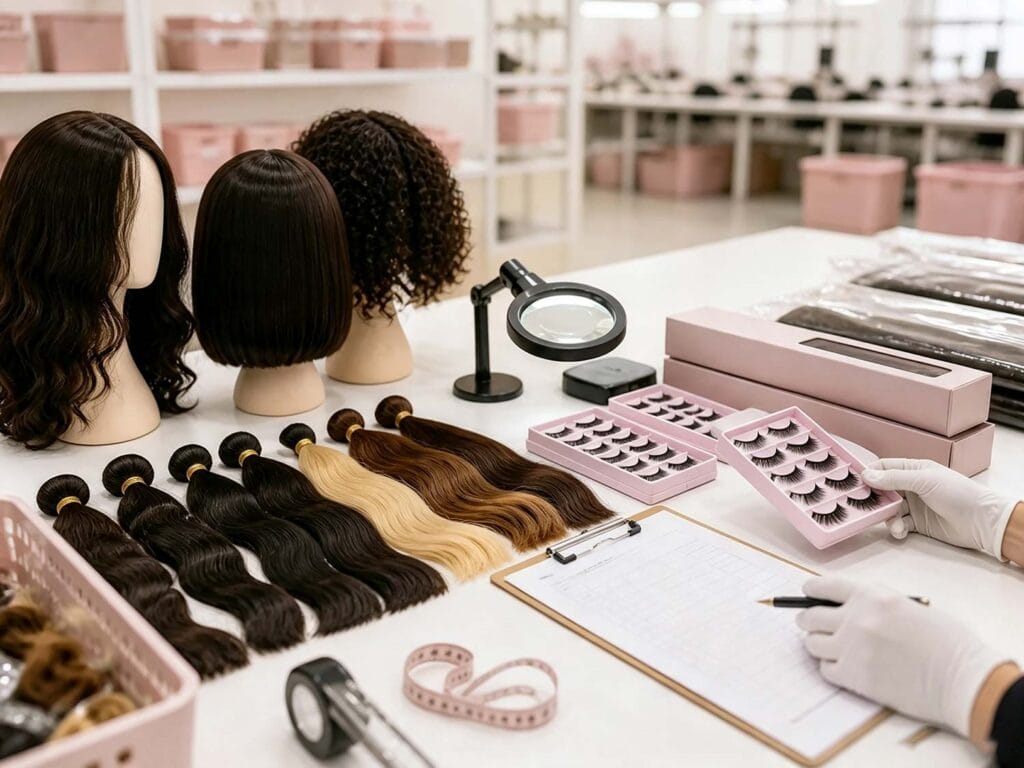
A sample should function as a technical reference, not merely as a visual preview. Before evaluating it, confirm which characteristics the sample is intended to represent.
Record the sample’s style code, fiber, color, length, cap construction, density, lace specification and packaging. Once approved, retain photographs, measurements and written comments. These records can become the reference standard for future production and inspection.
Evaluate samples under consistent lighting and review more than the hairstyle alone. Check the hairline, parting area, cap stitching, comb placement, elastic bands, fiber distribution, texture consistency and overall symmetry.
The following table can help organize the review:
| Inspection Area | What to Confirm | Possible Warning Sign |
|---|---|---|
| Fiber or hair | Texture, shine, softness and uniformity | Noticeable variation across sections |
| Length | Agreed measurement method and tolerance | Inconsistent measuring points |
| Density | Balanced distribution throughout the cap | Thin sections or excessive concentration |
| Cap construction | Size, stitching, elastic and attachment points | Loose seams or uneven construction |
| Lace area | Size, color, edge finish and hair placement | Rough edges or irregular ventilation |
| Color | Match with the approved reference | Variation under the same lighting |
| Packaging | Protection, labeling and presentation | Compression or incomplete information |
If a supplier cannot document the specifications represented by the sample, reproducing the same result later may be difficult.
5. Examine the Quality-Control Process
Quality control should cover incoming materials, production stages, finished products and packaging. Asking only whether the supplier “checks quality” rarely produces useful information. Instead, request an explanation of what is inspected, when it is inspected and how nonconforming products are handled.
For wigs, inspection points may include fiber or hair consistency, finished length, product weight, cap measurements, stitching, hairline appearance, texture, color, shedding and packaging. Different wig categories require different inspection priorities, so a single generic checklist is not enough.
Ask whether the supplier can inspect according to an approved sample and written specification sheet. It is also useful to understand whether inspection records, product photographs or shipment samples can be retained for reference.
A professional supplier should be comfortable discussing tolerances and corrective actions. Promising that every handmade or semi-handmade product will be absolutely identical is less credible than explaining how acceptable variation is controlled.
6. Test Communication and Specification Management
Communication quality often predicts how well a project will be managed. During the early discussion, observe whether the supplier answers each question clearly, confirms uncertain details and records specification changes.
Send a structured request containing several technical points. A capable supplier should respond item by item or provide a specification form. If important details are ignored repeatedly, the same problem may occur during production or packaging preparation.
Pay particular attention to change management. If the density, cap size, color, logo position or carton marking changes after sample approval, both parties should confirm the updated version in writing. File names and revision dates help prevent an outdated specification from being used.
Good communication also involves identifying risks early. A reliable partner should explain when a requested combination may affect appearance, production consistency or packaging rather than agreeing to every request without review.
7. Review Custom Packaging and Private-Label Support
Packaging is part of the finished product experience and an important element of inventory management. If you operate a private-label brand, ask what information the supplier needs for logos, color references, label dimensions, barcodes, warning text and carton markings.
Confirm whether the supplier can coordinate packaging for multiple wig styles without mixing labels or SKU information. For international distribution, inner packaging, retail packaging and export cartons must work together. Attractive retail packaging is not helpful if it compresses the wig or performs poorly during transportation.
Before final production, approve digital artwork and a physical packaging sample where appropriate. Verify spelling, colors, barcode readability, material, dimensions and product fit. Packaging approval should be documented separately from wig approval because they involve different quality criteria.
Companies sourcing several beauty categories may also benefit from coordinated wholesale wig and eyelash support, especially when mixed SKUs, private labels and shipment inspection need to be managed within one program.
8. Assess Export and Repeat-Supply Capabilities

A suitable supplier should support more than the first shipment. Ask how product specifications, samples, packaging files and inspection results are stored for future reference. Repeatability is particularly important for retailers and distributors that replenish established styles.
Review the supplier’s experience with export cartons, shipping marks, packing lists and coordination with freight partners. The supplier should understand the difference between product preparation and freight responsibility and should confirm the applicable shipping terms in writing.
Location can also affect logistics coordination. Suppliers based near major ports may be better positioned to consolidate products from different sources, arrange inspections and coordinate shipment handover. However, location alone is not enough; the supplier still needs organized documentation and clear communication.
Before confirming a long-term arrangement, test the complete workflow on a manageable project. Evaluate specification accuracy, communication, packaging, inspection evidence and delivery coordination. The purpose is to determine whether the same process can be repeated reliably.
A Practical Supplier Comparison Checklist
When comparing candidates, use the same evaluation criteria for every company.
| Evaluation Category | Questions to Ask | Evidence to Request |
|---|---|---|
| Company identity | Is the company information consistent? | Registration and official company details |
| Product knowledge | Does the team understand the requested wig type? | Detailed technical answers and specifications |
| Sample control | Can the sample become a documented standard? | Style code, photos and measurement records |
| Quality control | Which characteristics are inspected? | Inspection checklist or quality records |
| Communication | Are details confirmed accurately? | Written specification summary |
| Customization | Can packaging and labels be coordinated? | Artwork requirements and packaging sample |
| Mixed SKU support | Can several styles be managed correctly? | SKU list and packing method |
| Export coordination | Can the company prepare clear shipment records? | Packing list and shipping-mark process |
| Repeatability | Can an approved product be reproduced? | Archived sample and specification system |
Avoid selecting a supplier from a single attractive sample or a polished product image. The final decision should be based on documented systems, clear technical communication and evidence that the supplier can maintain agreed requirements.
Conclusion
Understanding how to find a wig supplier in China begins with defining your own requirements clearly. Once the specification is established, evaluate each supplier through the same eight areas: business identity, product specialization, sample control, quality inspection, communication, packaging support, export coordination and repeat-supply capability.
The strongest supplier relationship is built around traceable specifications and realistic expectations. A partner who asks detailed questions, documents decisions and explains how quality is controlled is generally better prepared to support a growing wholesale or private-label program.
Frequently Asked Questions
1. What information should I send to a wig supplier first?
Send the wig type, material, texture, length, color, cap construction, lace requirements, density, intended market, packaging needs and estimated SKU structure. Reference images can help communicate the desired appearance, but they should be supported by written specifications.
2. How can I verify whether a wig supplier is legitimate?
Review the company’s registration details, official contact information, website, business role and document consistency. Independent business verification may also be appropriate before beginning a major or long-term arrangement.
3. Should I choose a manufacturer or a supply-chain company?
The choice depends on the project. A specialized producer may suit a narrow product line, while a supply-chain company can be useful for mixed categories, coordinated packaging and consolidated shipments. The important point is that the company explains its role honestly and can control the agreed specifications.
4. What should I check when evaluating a wig sample?
Check the material, texture, color, finished length, density, cap measurements, lace area, stitching, hairline, symmetry, shedding and packaging. Record the approved characteristics so the sample can serve as a reference for later inspection.
5. How do I reduce quality variation in repeat shipments?
Use a detailed specification sheet, retain an approved sample, document every revision and agree on inspection criteria before production. Repeat shipments should be compared with the same reference rather than relying on general descriptions.
Need Help Evaluating the Right Wig Supply Solution?
CHY supports global wholesalers, distributors, retailers and private-label brands with synthetic wigs, hair bundles, false eyelashes, mixed SKU planning, packaging coordination and quality review. To discuss your product specifications and sourcing requirements, contact the CHY team.